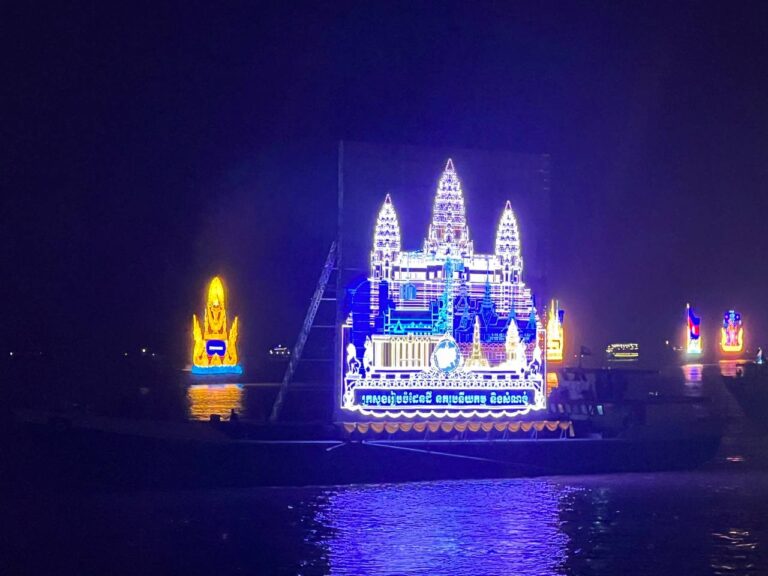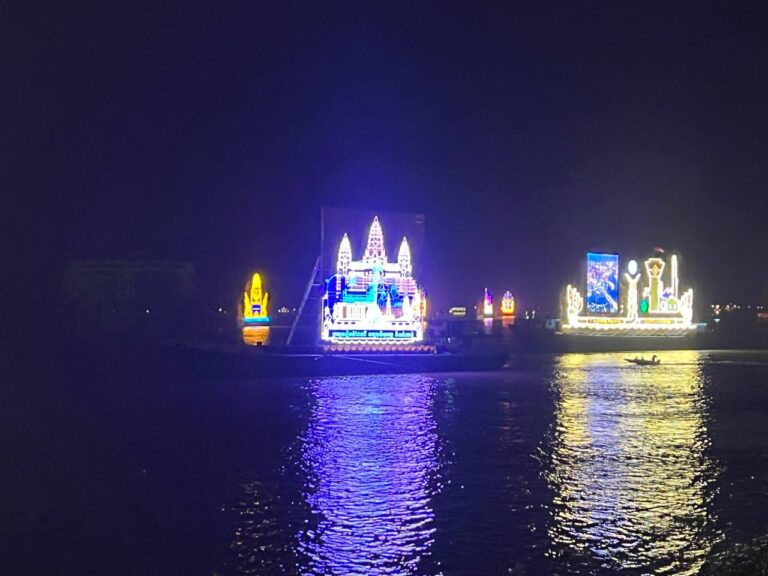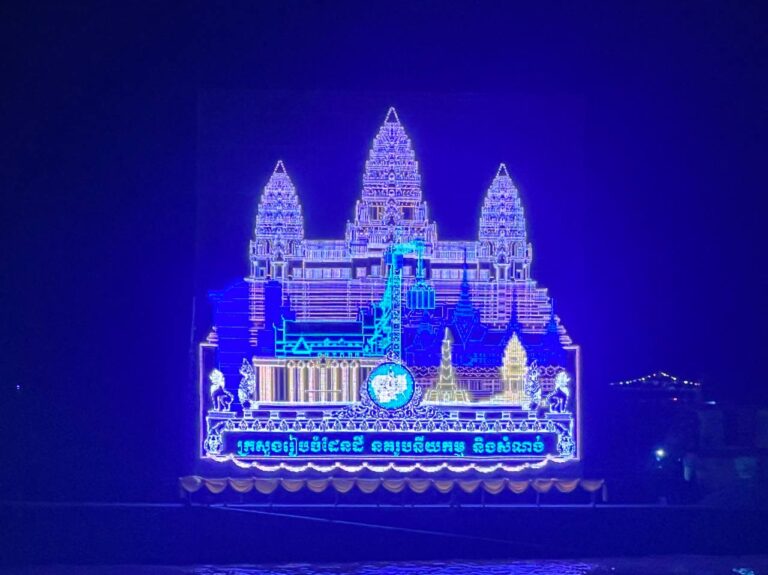
The Ministry of Land Management, Urban Planning and Construction presents “Cambodia’s Journey on the Angkor Civilization” reflecting aspects of Cambodian social development since the glorious Angkor period, the Chatomuk period and the present day, each of which has the following content:
1- The ship or “Cambodian Peace Ship” represents the country’s leaders, the guides who make Cambodia know peace and prosperity along the path of the Angkor civilization.
2- The Ministry of Land Management, Urban Planning and Construction’s badge and the Ministry’s logo represent the ministry’s institutions with the mission of leading and managing the work of land management, urban planning, construction, cadastre and geography of the Kingdom of Cambodia.
3- 25 kanjang patterns are located on the surface, representing the 25 provinces and cities of the Kingdom of Cambodia in the present day.
4- Angkor Wat in the background represents the pinnacle of the development of Khmer civilization, a repository of knowledge in Khmer art and architecture, the legacy of which has continued to this day and is included in the national flag of the Kingdom of Cambodia. This great temple was declared a World Heritage Site by UNESCO on December 14, 1992.
5- The dragon is the king of the animals, representing the traditional cultural path and customs of the Khmer people, which have continued from the Angkor period to the present day, and represents the element of water, which is the source of life for all living things.
6- The lion or lion or lion is the king of the powerful animals. In the Khmer view, the lion is a symbol of power, courage, and helps to repel evil spirits. It is an animal that represents the influence of nature, which is both terrifying and respectful. The lion also represents the power of the land, which is combined between the dragon and the lion, representing the planets with the elements of water and earth, which are important elements in supporting each other, spreading living and non-living things to live and breathe on the planet in harmony.
7- The Royal Palace is a Chatomuk architecture that continued from Angkor architecture, representing the style of medieval architecture. The Royal Palace has an ornate building with a multi-story roof, golden tiles, and a central tower with a pointed top, which is a symbol of endless progress and represents the nation, religion, and the king.
8- The Independence Monument is a Khmer architectural style that continued from the Angkor architecture, symbolizing Cambodia's full independence from the French protectorate in 1953. The monument was built in 1958, which was the work of King Norodom Sihanouk, the King of Cambodia.
9- The Senate Building is an architectural style from the independence era that continued from Angkor architecture. The Senate is the legislative body of the Kingdom of Cambodia, which has the task of fine-tuning laws and coordinating the work between the National Assembly and the Royal Government. The Senate plays an important role in democratizing society and in building Cambodia as a constitutional state, and in contributing to the process of stabilizing and democratizing the political life of the nation, as the core of strengthening politics, unifying, reconciling the nation, and developing the nation to prosperity and prosperity.
10- The National Assembly Building is an architectural style from the peace era that continued from Angkor architecture, representing the style of contemporary architecture. The National Assembly is the legislative body of the Kingdom of Cambodia, which has the task of reviewing and approving draft laws or proposals for laws and electing the Royal Government.
11- The Win-Win Monument represents the Win-Win policy, which is the policy to extinguish the flames of war in Cambodia. It was implemented on February 11, 1996, and was completely closed on December 29, 1998, making Cambodia peaceful after the end of the long-standing civil war, under the wise leadership of Samdech Akka Moha Sena Padei Techo Hun Sen, who is the founder of this great policy and represents the national unification, national independence, solidarity, territorial integrity, progress and prosperity of the whole of Cambodia.
12- The Ministry of Land Management, Urban Planning and Construction building is a peacetime architecture that continued from the Angkor architecture, representing the contemporary architectural style or contemporary style by synthesizing the architectural styles of the Angkor period, the Chatomuk period and modern times, representing the progress of the architecture and construction sector in the context of Khmer modernization.
13-The Peace Palace represents the supreme leadership institution and the location of the policy launch that has led Cambodia to achieve peace on a win-win political path and progress in all sectors.
14-The tall building represents the progress in the field of urbanization and construction under the shadow of peace.
15-The crane represents the latest construction technology and the continued progress in the construction and human resources sectors.