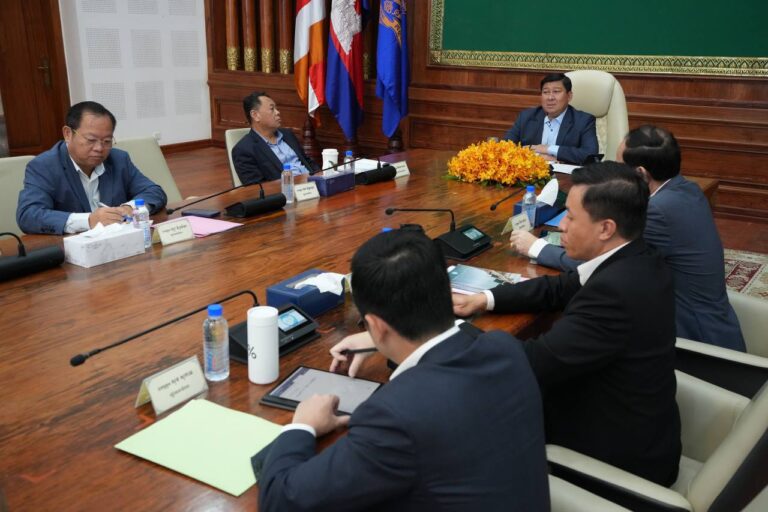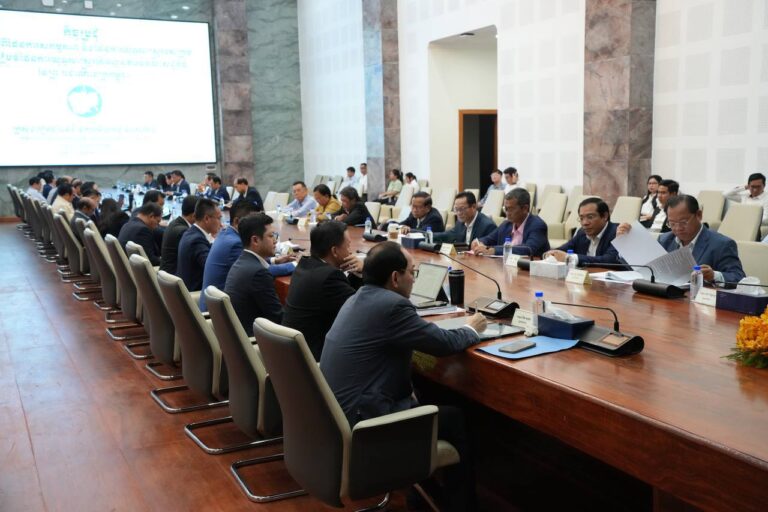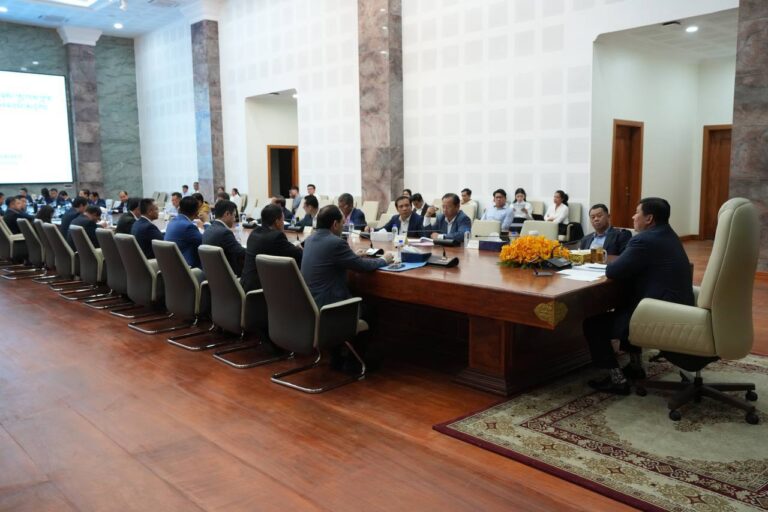
(Phnom Penh): The leadership of the Ministry of Land Management, Urban Planning and Construction has urged the working group for the strategic planning of the development of the economic poles of the Kingdom of Cambodia to consider regional potential, geographical factors, natural resources and physical infrastructure in accordance with policies and laws, national legal norms and regional and international frameworks to develop the socio-economic and human capital that are in harmony with a good living environment.
His Excellency Deputy Prime Minister Say Samal delivered a speech at the meeting to promote the action plan and strategic plan of the working group for the strategic planning of the economic poles of the Kingdom of Cambodia on the morning of May 20, 2024 at the Ministry’s office.
His Excellency added that Cambodia has transformed itself from a poor country to a lower-middle-income country, with a vision to become an upper-middle-income country by 2030 and a high-income country by 2050. Therefore, the purpose of preparing the strategic plan for the development of economic poles is to determine the direction of land use in Cambodia to be more efficient, sustainable and modern, in accordance with strategic policies and legal documents, with the aim of promoting national economic growth, improving the livelihood of citizens and contributing to the realization of Cambodia’s 2050 vision as a high-income country.
For the 7th term of the National Assembly, the Royal Government has launched the first phase of the Pentagon Strategy for Growth, Jobs, Equity, Efficiency and Sustainability, aiming to build the foundation to achieve Cambodia’s 2050 vision by identifying five key priorities, including “People, Roads, Water, Electricity and Technology”.
To contribute to the realization of the vision and political programs as mentioned above, the Ministry of Land Management, Urban Planning and Construction has considered preparing a strategic plan for the development of economic poles in the Kingdom of Cambodia to study and identify economic poles, develop major economic corridors in Cambodia to support and orient socio-economic development, manage the environment and natural resources, ensure food security, promote culture and national identity, and ensure sustainability, balance and improve economic competitiveness.