
(Siem Reap): The Ministry of Land Management, Urban Planning and Construction (MLMP) has said that the preparation of a master plan for land use in Siem Reap and five other provinces around Tonle Sap Lake will be used as a model for implementation across the country to improve people’s livelihoods and boost national economic growth.
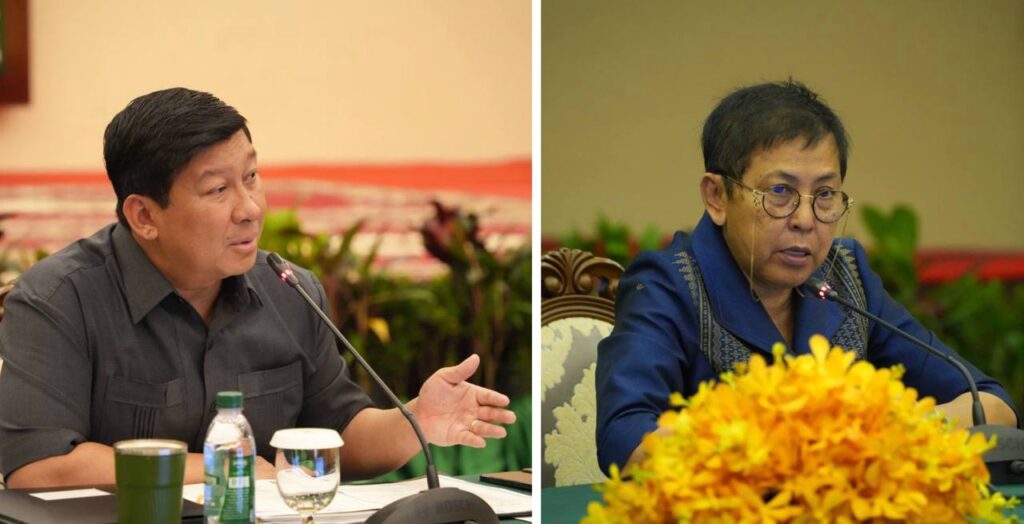
Speaking at a consultation meeting on the management of the Tonle Sap Lake and Angkor Resort areas held in Siem Reap, attended by Her Excellency Dr. Phoeung Sakona, Minister of Culture and Fine Arts, His Excellency Hang Pov, Director General of the Apsara National Authority, and representatives of the Ministry of Water Resources and Meteorology, as well as the Tonle Sap Authority, on the morning of August 25, 2025.
His Excellency Deputy Prime Minister Say Samal requested that the Tonle Sap Authority agree to participate in implementing work in the Tonle Sap Lake area and said that the Ministry of Land Management, Urban Planning and Construction (MLMP) will implement land use planning in six provinces around Tonle Sap Lake. The Deputy Prime Minister stated that we have a working group divided into 131 communes in the six provinces around Tonle Sap Lake to prepare the master plan for land use. In general, starting from 114 villages related to the Angkor heritage area and continuing throughout Siem Reap Province, the master plan for land use must be completed throughout the province.
The Deputy Prime Minister added that the preparation of the master plan for land use in Siem Reap Province and the five other provinces around Tonle Sap Lake will be used as a model for implementation nationwide to improve the livelihood of citizens and promote national economic growth. By preparing the master plan for land use, along with the establishment of a commune fund, the Ministry of Economy and Finance will be able to provide funds in accordance with the planning projects in each commune, which is a special strategy to achieve the vision of the Royal Government of Cambodia for 2030 and 2050.
According to the progress report of the working group of the Department of Land Management, Urban Planning, Construction and Cadastre of Siem Reap Province, it said:
1: The Tonle Sap region under the jurisdiction of Siem Reap Province has 33 communes and sangkats. The working group has prepared two communes, namely Por Trai commune, Puok district, and Krung Phlok commune, Prasat Bakong district, and is preparing two more communes and sangkats, namely Chong Khnaes commune, Siem Reap city, and Kampong Khleang commune, Sot Nikom district.
2: Angkor World Heritage Site: Angkor has 114 villages. The team has prepared 4 villages: Chaad village, Puok district, Sra Srang village, Nokor Thom commune, Siem Reap city, Sra Srang village, Nokor Thom commune, Siem Reap city, Preah Dak village, Preah Dak commune, Banteay Srei district, and the team is preparing 5 more villages: Awlok village, Bakong commune, Prasat Bakong district, Lalai village, Bakong commune, Prasat Bakong district, Steung village, Bakong commune, Prasat Bakong district, Chambok village, Roluos commune, Prasat Bakong district, and Daun Teav village, Roluos commune, Prasat Bakong district.
This is another important step by the Ministry of Land Management, Urban Planning and Construction, the Ministry of Culture and Fine Arts, the Royal Government Working Group in Siem Reap, the Apsara National Authority, the Tonle Sap National Authority, the Siem Reap Administration, and the six provincial administrations around the Tonle Sap area in organizing consultations to seek a consensus map on the preparation of a master plan, land use plan, through the determination of land use conditions and urban planning and construction management in the Angkor World Heritage Site and Tonle Sap Lake area, before moving on to preparing a master plan for land use in all 1,652 communes nationwide.
Please be informed that this consensus map is a guiding tool to move forward with the implementation of a land use plan that is agreed upon between citizens and relevant authorities, improving the livelihoods of Angkor residents and residents around Tonle Sap Lake, and strengthening the national economy based on the use of land resources, so that Cambodia can live independently and be independent of its owners.