
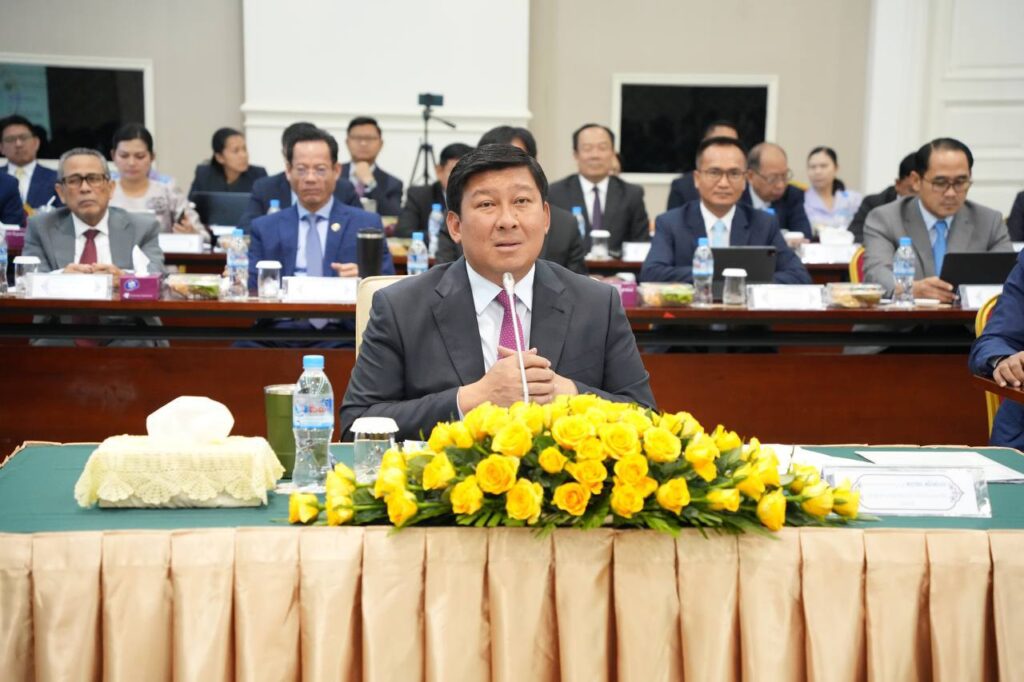
(Phnom Penh): The leadership of the Ministry of Land Management, Urban Planning and Construction has been implementing the battle according to its work plan to continue the legacy of peace within the ministry and to make this legacy a foundation in Cambodian society, preventing the return of division for future generations. At the same time, after completing the creation of a conflict-free environment, the ministry has turned to the work of land management and urban planning by building towns and public spaces to be alive and improving the lives of Cambodian people and contributing to building the Cambodian economy so that Cambodia is a strong, self-sufficient and independent country.
Speaking at a presentation ceremony to provide insight into the governance and implementation plan in the field of land management, urban planning and construction to the Supreme Council for Consultation and Advice on October 7, 2025, at the Council of Ministers.
It is worth noting that the ministry’s 9 battles include:
1. Organizing the house in order: Continuing the work and operation of the institution, maintaining the spirit and consciousness of the people, maintaining unity, internal unity, and building faith and confidence in the overall leadership
2. Creating a dispute-free environment: Complete land registration, resolving land disputes, satisfactory services, preserving the life of Tonle Sap Lake, the Siem Reap-Angkor resort area, resolving disputes in the Borei
3. Building and strengthening a modern, smart and agile public administration: Strengthening institutional capacity, strengthening the capacity of officials, budget and financial bases, incentive systems for officials, education and dissemination work, reviewing and analyzing the functions and structures of ministries, and preparing policies, laws, regulations and legal documents
4. Land and urban planning work: Designating conservation areas, agricultural areas, commercial areas, special economic zones, townships and cities, building towns as rural Borei, Thankhem Ksan villages, and Trang Sopheak, organizing corridors and economic poles, organizing parks and public spaces
5. Housing: Development of “affordable housing”, housing fund, old dilapidated buildings, unorganized construction
6. Concession policy for society and economy: Land and housing allocation, provision of all kinds of animal and crop varieties, community building and necessary physical infrastructure, export on the spot, one village, one product
7. Contemporary Khmer architecture in Cambodia: Construction and architecture sector, considering safety, quality and aesthetics, contemporary style and design, construction law, risk reduction and disaster management in the construction sector, management of professionals in the construction and architecture sector
8. Decentralized and decentralized reform work
9. Prosperous Cambodia, economic breath: Construction industry, construction materials industry, furniture industry, decoration industry, real estate industry, finance and banking industry, loan industry.